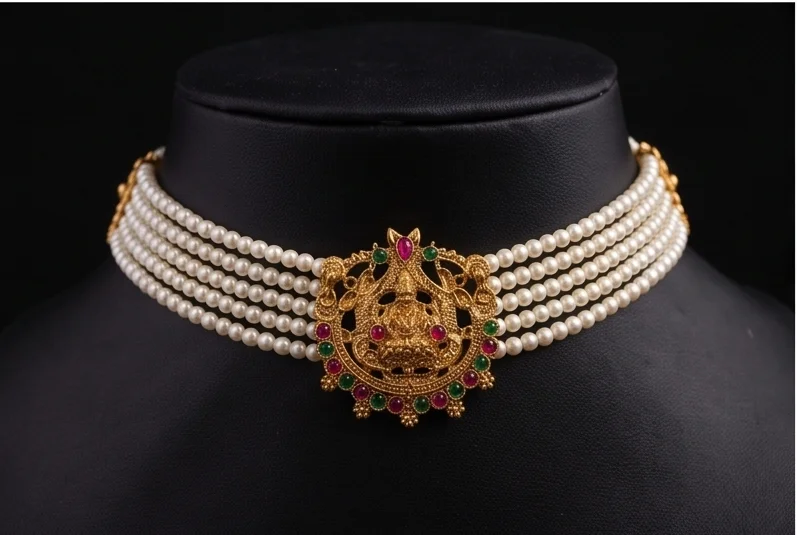
Walk into any South Indian jewellery store and the first thing that catches your eye is the unmistakable burst of deep red and green against antique gold. That is kemp stonework: the centuries-old craft of setting coloured glass stones to create the look of precious gems. It is the single most defining visual element of temple jewellery, and understanding it is essential for any wholesale buyer who wants to stock pieces that sell.
What Are Kemp Stones? Coloured Glass, Not Plastic
Kemp stones are coloured glass: not plastic, not resin, and certainly not synthetic crystal. The glass is pigmented during manufacture to produce deep, saturated hues that mimic precious gemstones. Ruby red, emerald green and sapphire blue are the classic variants, though modern kemp work also includes amethyst purple, topaz gold and turquoise. The key distinction from cheaper alternatives is weight and brilliance: glass kemp stones have a satisfying heft and catch light differently from plastic imitations. When a customer picks up a kemp-studded haaram and feels its weight, they know it is quality work.
How Kemp Stones Are Made: Cut, Polish, Foil-Back
The process begins with sheets or rods of coloured glass, which are hand-cut into small cabochons: domed on top, flat at the base. Each piece is then polished on a lapidary wheel to achieve a smooth, glossy surface. The critical step is foil-backing: a thin metallic foil is applied to the flat underside of the stone. This foil reflects light back through the glass, multiplying its apparent brilliance. Without foil-backing, even the finest coloured glass looks dull and flat. With it, a simple glass cabochon transforms into something that reads as ruby or emerald to the eye.
Hand-Setting vs Machine-Setting: Why It Matters
Kemp stones are hand-set, one by one, into metal settings using prongs, bezels or closed-back collets. This is not an aesthetic choice: it is a structural necessity. Glass, unlike diamond or cubic zirconia, cannot withstand the pressure of machine-setting without cracking. Each artisan uses hand tools to gently seat the stone and bend the setting claws around it. The result is a setting that holds securely while allowing the foil-backing to do its work. Machine-set kemp stones, by contrast, tend to crack within weeks or lose their foil backing, resulting in dull, lifeless pieces that no retailer wants on their shelves.
The Defining Feature of Temple Jewellery
Kemp stonework is temple jewellery. Without it, you have gold-toned metalwork: attractive, but not recognisably South Indian. The deep ruby-red kemp against antique gold is the visual signature of the tradition, instantly recognisable whether on a Lakshmi haaram, a Guttapusalu necklace or a pair of temple jhumkas. Emerald green and sapphire blue accents add depth and contrast. A single elaborate haaram may feature three or more kemp colours, each one individually hand-set into its own compartment within the metal frame.
How Jagruti Artisans Hand-Set Every Stone
At Jagruti Imitation Jewellery, kemp stonework is not an afterthought: it is the craft that anchors our entire temple jewellery range. A single elaborate haaram can contain hundreds of hand-set kemp stones, each placed by an artisan who has spent years mastering the technique. Our Kandivali East workshop in Mumbai sources coloured glass from specialised suppliers, and every stone is inspected for colour consistency, foil integrity and cut quality before it reaches the setting bench. Unlike mass-produced pieces where stones are glued into place, our settings are mechanical: pronged or bezel-set, meaning they will not fall out during retail handling or customer wear.
For wholesale buyers, understanding kemp stonework means understanding quality differentiation. It is the difference between a piece that sells at full margin and one that gets returned. Browse our wholesale catalogue to see kemp work across our entire range, or explore our custom design service if you have specific stone colour or setting requirements for your market.
Want to see our kemp stonework up close?
Apply for Wholesale Pricing →