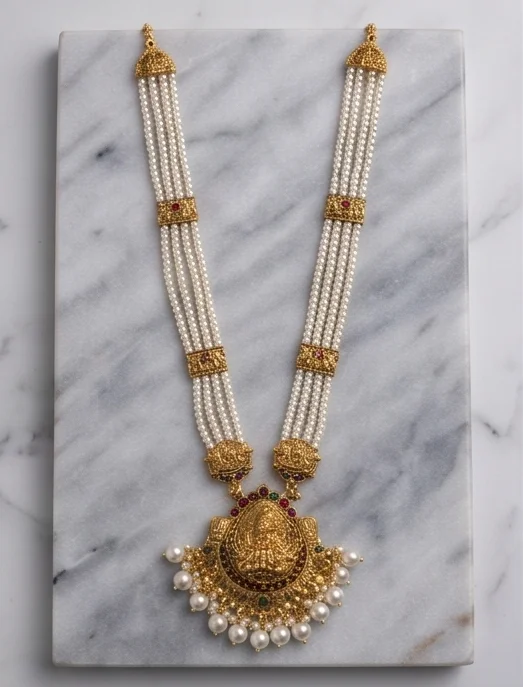
The Guttapusalu haaram is among the most recognisable and cherished heritage necklaces of South India. Its origins trace back to the pearl-fishing communities along the Andhra Pradesh coast — particularly the coastal regions near Machilipatnam and the Coromandel belt — where natural pearls were once harvested from the Bay of Bengal and crafted into elaborate ornaments for royalty and temple deities. Today, this regal design has found new life in the wholesale imitation jewellery trade, where it remains one of the most sought-after styles for bridal and festive collections across India and the global diaspora.
Meaning of 'Guttapusalu': A Bunch of Pearls
The name itself tells the story. In Telugu, 'Gutta' means a cluster or bunch, and 'Pusalu' refers to pearls or beads. The Guttapusalu haaram is quite literally a bunch of pearls — a design philosophy that distinguishes it from every other South Indian necklace. Unlike a single-strand pearl necklace, the Guttapusalu features multiple parallel strands of pearls that cascade from a central pendant, creating a dense, layered look that radiates opulence and tradition. This multi-strand architecture is what gives the Guttapusalu its unmistakable silhouette and commanding presence on the wearer.
Design Elements: Lakshmi, Kemp and the Pearl Cascade
At the heart of every Guttapusalu haaram lies a Lakshmi centrepiece — the goddess of wealth, rendered in detailed metalwork with an antique gold finish. Flanking the Lakshmi motif are kemp stone accents, those deep-red and green coloured glass stones that define temple jewellery. The kemp work adds punctuation and contrast against the ivory-white pearl strands, creating a palette that is at once rich and harmonious. From the centrepiece radiates the signature cascade — anywhere from three to seven pearl strands on each side, each strand progressively longer than the one above, forming a graduated waterfall effect. The back of the haaram is typically finished with a broad, decorative clasp or a shorter pearl chain that ensures the weight sits comfortably across the neckline.
Why the Guttapusalu Dominates Wholesale Demand
In the B2B imitation jewellery market, the Guttapusalu haaram is a perennial bestseller for several reasons. First, it bridges the temple jewellery and pearl jewellery categories — two of the highest-margin segments in Indian ethnic fashion. A single Guttapusalu piece can serve multiple customer profiles: the bride looking for something traditional yet distinctive, the festival shopper wanting an heirloom-quality statement piece, or the NRI customer seeking an authentic South Indian design. Second, the multi-strand construction means there is inherent perceived value — customers understand that more strands equal more craftsmanship. Third, the design photographs beautifully, making it ideal for e-commerce and social media retail, where visual impact drives purchase decisions.
How Jagruti Recreates the Guttapusalu
At Jagruti Imitation Jewellery, we have been manufacturing Guttapusalu haarams for the wholesale trade since 2005. Our artisans in Kandivali East, Mumbai, use high-grade imitation pearls — lustrous, weighty beads that mimic the sheen and heft of cultured pearls — combined with an antique gold finish applied through multi-stage electroplating over brass or Mazak base. The Lakshmi centrepiece is cast from a precision mould and hand-finished, while the kemp stones are individually set by skilled karigars trained in traditional South Indian stonework techniques. Every strand is measured, knotted or linked, and quality-checked before despatch. Using Rhino 3D CAD technology, we can also reproduce specific Guttapusalu designs from reference images, making us a trusted partner for retailers and distributors who need faithful recreations of heritage styles.
Customisable for Every Market
One of the strengths of the Guttapusalu design is its adaptability. We offer customisable lengths — from a shorter 3-strand version suitable for younger customers or everyday ethnic wear, to a full 7-strand bridal haaram that makes a dramatic statement. Bead colours can also be adjusted: while classic ivory-white pearls remain the most popular, we manufacture variants with gold-tinted pearls, soft pink pearls for the bridal market, and even black pearl Guttapusalu designs that appeal to customers looking for a contemporary twist on tradition. The antique gold finish can be darkened or lightened based on regional preferences — North Indian markets often prefer a brighter gold, while South Indian and export markets gravitate towards a deeper, aged patina.
A Heritage Worth Stocking
The Guttapusalu haaram is more than a product — it is a piece of Indian cultural heritage that tells the story of coastal Andhra's pearl-fishing legacy, centuries of temple craftsmanship, and the enduring appeal of South Indian ornamentation. For wholesale buyers, it represents a category-defining SKU that performs reliably across seasons, geographies, and customer segments. Browse our wholesale catalogue to see our full range of Guttapusalu and temple haarams, or apply for trade pricing to place your next order.
Want a Guttapusalu haaram in your next wholesale order?
Apply for Wholesale Pricing →